Latest Info on Philippines gov spend, Public Purchasing, Govt budget & Public spending
- Home >
- Public Procurement
Public Procurement in Philippines
Public procurement in the Philippines is a foundational component of government operations and national development. Through public procurement, the government acquires goods, undertakes large-scale infrastructure works, and contracts services essential for public administration, social programs, disaster response, and economic growth.
The Philippine public procurement system is governed by a comprehensive legal framework and supported by a centralized electronic procurement platform. Procurement activities are conducted across national government agencies, local government units, state universities, government-owned and controlled corporations, and constitutional bodies.
For domestic suppliers, SMEs, multinational companies, and development partners, government tenders in the Philippines represent one of the largest procurement markets in Southeast Asia, characterized by high transaction volumes, strong transparency requirements, and increasing integration of sustainability and social policy objectives.
Country & Economic Overview
| Region | East Asia and Pacific |
| Population | 117.3 million (2024) |
| Income Level | Lower middle-income economy |
| Base Currency | Philippine Peso (PHP) |
| Average Exchange Rate (PHP/USD) | 54.47778584 |
| Gross Domestic Product (USD) | USD 461.6 billion (2024) |
| Gross National Income (USD) | USD 521.8 billion (2024) |
| GNI per Capita (USD) | USD 4,470 (2024) |
Public procurement expenditure represents approximately 13% of GDP, highlighting its substantial role in fiscal execution and economic activity.
Public Procurement Governance Framework
- Public Procurement Policy Authority: GPPB
- Operational Procurement Entity: PS
- Oversight Ministry: Department of Budget and Management
The GPPB formulates procurement policies, issues implementing rules and resolutions, and oversees compliance with procurement law. The Procurement Service acts as the national Central Purchasing Body, conducting bulk procurement, framework agreements, and catalogue-based purchasing on behalf of government entities.
The Procurement Service operates at national level and covers sectors including agriculture, education, health, transport, ICT, public administration, energy, water, and social protection.
Legal & Regulatory Framework
Public procurement in the Philippines is governed by the Government Procurement Reform Act and its implementing rules and regulations.
- Government Procurement Reform Act (Republic Act No. 9184)
- Implementing Rules and Regulations (IRR)
- GPPB Resolutions and Circulars
Key Legal Principles and Clauses
- Bid securities - Section 27, RA 9184
- Public bid openings - Section 29, RA 9184
- Domestic preference - Section 43, RA 9184
- Complaint resolution - Section 55, RA 9184
- Bid validity - Section 28, RA 9184
- Lowest Calculated and Responsive Bid (MEAT equivalent) - IRR Section 37.1.1
- Value for Money and Total Cost of Ownership - Framework Agreement Guidelines, Section 6.1.4
Sustainability and green procurement are supported through multiple GPPB resolutions forming a structured Green Public Procurement regime.
Procurement Procedures & Thresholds
| Aspect | Legal Reference |
| Tender thresholds | Annex H, Section V (C) and (D)(8) |
| Advertisement period | Section 21.2 and Annex H, Section IV (E) |
| Standstill period | GPPB Circular No. 06-2019, Section 8 |
| Bid validity | Section 28, RA 9184 |
The minimum number of days from advertisement to contract award ranges from 25 calendar days, depending on procurement method, complexity, and early procurement activities.
The average bid evaluation period is approximately 7 days.
E-Procurement System in the Philippines
| System Name | Philippine Government Electronic Procurement System (PhilGEPS) |
| Website | https://www.philgeps.gov.ph/ |
| Launch Year | 2000 |
| Ownership Model | Government owned and operated |
| Supported Languages | English |
| Supported Currency | Philippine Peso |
| Core Functionalities | ePublishing, eTendering, eCatalogues, Vendor Management, eEvaluation, eContract Management, ePurchasing (P2P) |
PhilGEPS is used by all government entities and is also recognized by the World Bank for procurement-related processes. Tender documents are downloadable, and procurement analytics are published through open dashboards.
Procurement Market Characteristics
| Category | Number of Awards | Value (USD) |
| Goods | 251,113 | 3,981,016,460 |
| Works | 36,592 | 7,543,909,602 |
| Services | 12,174 | 245,830,956 |
The Philippines records very high procurement volumes, with over 1,000,000 tenders annually. Procurement is dominated by domestic suppliers, while international participation is more common in infrastructure and donor-funded projects.
Transparency, Complaints & Oversight
- Average complaint resolution period: 7 days
- Cancelled procurement procedures: 11,600
- Mandatory publication of procurement monitoring reports
- Public analytics portal for procurement data
Transparency is reinforced through PhilGEPS open data dashboards and regular procurement monitoring reports issued by the Procurement Service.
Sustainability & Green Public Procurement
The Philippines has one of the most advanced green public procurement frameworks in the region.
- National Green Public Procurement roadmap approved
- Mandatory green specifications for 10 prioritized common-use supplies
- Lead agencies: GPPB and Procurement Service
- Green procurement monitoring tools in place
Green procurement is mandatory for selected product categories and optional for others, supported by detailed technical specifications.
Social & Ethical Procurement Considerations
The Philippine procurement system integrates social policy objectives.
- Domestic preference mechanisms under RA 9184
- Mandatory allocation of at least 10% of procurement to persons with disabilities
- Gender-responsive procurement strategies adopted in 2023
While no fixed spend targets exist for women-owned businesses, policy instruments increasingly support inclusive procurement.
Key Challenges & Practical Insights for Bidders
Key Challenges
- High competition due to large supplier base
- Strict compliance and documentation requirements
- Complexity of procedures for large infrastructure projects
Practical Tips for Bidders
- Maintain active PhilGEPS registration and appropriate membership level
- Monitor Annual Procurement Plans published by agencies
- Ensure strict compliance with bid security and documentary requirements
- Understand green specification requirements for applicable product categories
Public Procurement in the Philippines represents a large-scale, transparent, and increasingly sustainable procurement environment. For suppliers seeking government tenders in the Philippines, success depends on strong compliance discipline, familiarity with PhilGEPS, and alignment with evolving sustainability and social procurement policies.
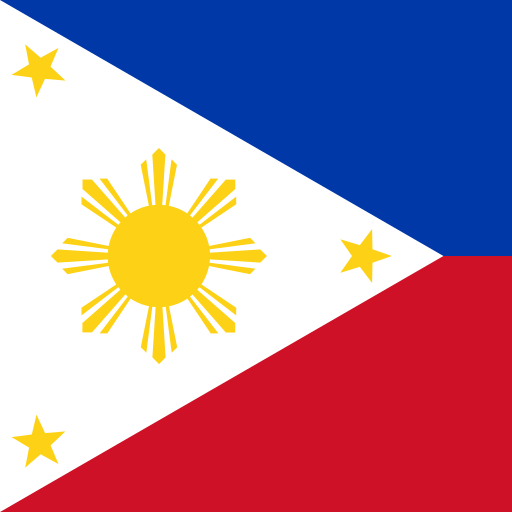
Flag of Philippines
Emblem of Philippines
Capital
Manila
ISO 3166 Code
PH
Population
100,836,000
Area, Sq KM
300,000
Currency
Philippine Peso
GDP, Billion USD
2,72,067
Language
Filipino, English
GDP Growth Rate, %
6.2
Inflation, Avg CP, %
-
Interest Rates, %
-
Unemployement Rate, %
6.9
Exchange Rate, 1 USD Equals
44.98
International dial code
63
Time ZONE
GMT+08:00
Internet TLD
.ph
Get FREE SAMPLE TENDERS from Philippines in your email inbox.
Copyright © 2014-2026 PhilippinesTenders.com. All Rights Reserved.